


|
 |
|||
| Calle Schewen's Waltz | |||
| Sweden, 1987, 23 min, 16 mm, colour, 1:1.37 | |||
| Director: Håkan Alexandersson | |||
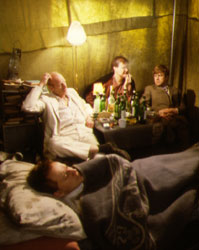
| Calle von Schewen, a living, breathing person from the real world, sits around one evening with a few friends. They´re awaiting airline-stewardesses and the bar is well stocked. |

 |
|||
| Cast | Calle von Schewen, Tomas Norström, Gert Fylking, Cecilia Wallton, Anna von Schewen, Göran Torell, Pernilla Börnfors, Lisa Dalin, Marie-Louise Berzén. | ||
| Director | Håkan Alexandersson | ||
| Screenplay | William Shakespeare (translation by E. Appelgrens), Calle von Schewen et.al. | ||
| Cinematography | Christer Strandell | ||
| Focus puller | Stickan Olsson | ||
| Sound | Ulf Mattmar | ||
| Editor/sound effects | Thomas Täng | ||
| Set painter | Kristina Elander | ||
 |
||
Calle von Schewen, a living, breathing person from the real world, sits around one evening with a few friends. They´re awaiting airline-stewardesses and the bar is well stocked. But...it´s not as simple as that. During the 80s, most of the actors in the Meyer Studios films came from private theatre groups such as Galeasen and Pistolteatern. The latter group experienced a crisis in conjunction with their unsuccesful version of Hamlet, and one day Hamlet, the King and Ofelia found themselves sitting around the kitchen table at Meyer´s office on Västmannagatan.The short film Alexandersson & De Geer had planned was to revolve around von Schewen, but had suddenly taken a new direction. Adequate dialogue was certainly not missing with the present actors around. The party at von Schewen's place was rather bizarre. His actual apartment was copied and built at the studios in the old foundary. Erik Appelgrens exceptional prose-translation of Hamlet´s and Ofelia´s monologues are mixed with Calle´s theories on women and his tales of his father. Most of "Calle Schewen's Waltz" was shot in the heat of the moment during late-night seances. It's an unusual film, bits of it are fragmentary, bits of it are not to easy to understand. One could say a mixture of Shakespeare and "underground film" in the spirit which was coined in the early 1960's "New American Cinema". |
||

