


|
 |
|||
| Never Travel... | |||
| Sweden, 1987, 12 min, 35 mm, colour, 1:1.66 | |||
| Director: Håkan Alexandersson | |||
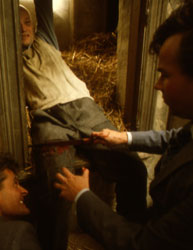
| A dark episode from a derelict future when an outcast tries to endure his last day. The alcohol is rough and unfiltered. Desperate violence sprouts from the struggle to survive. But the violence is so strange that it is borderline to comedy. The hit-men claim thay they are speech-therapists; and that they are on the hunt for some covered-up secret. |

 |
|||
| Cast | Mats G. Bengtsson, Mikael Samuelson, Ted Åström, Urszula Hildén, Thomas Lundqvist samt Teatergruppen Galeasen. | ||
| Director | Håkan Alexandersson | ||
| Screenplay/ production design | Carl Johan De Geer | ||
| Director of photography | Christer Strandell | ||
| Sound/ editor | Ulf Darin | ||
| Costume/ make up | Kristina Elander | ||
| Music | Guiseppe Verdi | ||
 |
||
This short-film shouldn't be confused with the feature, "Never Travel on a One-way Ticket". It's a pilot-film made for the purpose of gaining financing from the money-men at the Film Institute. All the same, "Never Travel..." is still a peculiar film. A dark episode from a derelict future when an outcast tries to endure his last day. The alcohol is rough and unfiltered. Desperate violence sprouts from the struggle to survive. But the violence is so strange that it is borderline to comedy. The hit-men claim thay they are speech-therapists; and that they are on the hunt for some covered-up secret. The outcast survives. But then, a woman gets the best of him. We won't give the ending away, but the border between dream and reality is diffused as is the border between jokes and seriousness. It was with "Never Travel..." that they discovered the possibilities of making science-fiction movies at the old foundary on Västmannagatan. The actors in "Never Travel..." and "Never Travel on a One-way Ticket" have totally different roles in both of the films. "Never Travel..." was shot in colour, but it was printed in black and white, as an experiment. Only one of the three layers of colour on the negative were used. The result being an extremely grainy print. After an arduous search for the negative, it was finally found in 1991, and a new print was made, this time in colour. |
||

