


|
 |
|||
| Werther | |||
| Sweden, 1990, 90 min, 35 mm, colour, 1:1.66 | |||
| Director: Håkan Alexandersson | |||
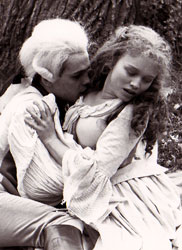
| "The sorrows of young Werther" is a novel by Goethe, written in 1774 when he was very young. The book is full of pained love and of a melancholy that reminds us of Hamlet. As a consequence of the novel, many young men committed suicide. Already for the second edition, Goethe was forced to add an epilogue; "Sei ein Mann und folge ihm nicht nach" - be a man and don't do as he did. |

 |
|||
| Cast | Tomas Norström, Lena Strömdahl, Gert Fylking, Ellen Lamm, Peter Kneip, Ulrika Hansson, Peter Sjöqvist, Göran Thorell, Jon Mellqvist, My Liljander, Irma Schultz, Pernilla Glaser, Nina Hols Ahlbom, Sophie Tolstoy | ||
| Director | Håkan Alexandersson | ||
| Screenplay | Håkan Alexandersson, J.P. Ecker-mann, J.W. von Gœthe, Tomas Norström | ||
| Production design /costume/ set painter |
Carl Johan De Geer | ||
| Executive producers | Freddy Olsson, Lisbeth Gabrielsson | ||
| Director of photography | Christer Strandell | ||
| Sound | Ulf Mattmar | ||
| Editor | Thomas Täng | ||
| Music | Kjell Westling | ||
| Produced by Alexandersson & De Geer Bildproduktion for Swedish Television. Shot in 1972. Broadcasted in Sweden 1973 with many re-runs since then. | |||
 |
|||
The old foundary on Västmannagatan was evacuated in 1988. The production company moved to Ingemarsgatan by Roslagstull. There they found an empty hospital from the 19th century where they had shot parts of "NOA". This proved a most ideal setting to shoot the film, "Werther". "The sorrows of young Werther" is a novel by Goethe, written in 1774 when he was very young. The book is full of pained love and of a melancholy that reminds us of Hamlet. As a consequence of the novel, many young men committed suicide. Already for the second edition, Goethe was forced to add an epilogue; "Sei ein Mann und folge ihm nicht nach" - be a man and don't do as he did. Håkan Alexandersson discovered a book that wasn't easy to adapt for the screen. On the other hand, it was quite suitable as the material our fictional film-maker, Max Karlsson struggles with, endeavouring to transfer it to cellouid. The gloominess of the 18th century is definately there, but the parallel narrative from our time gives the original material an unexpected double-meaning, and moments of great comic relief. Max Karlsson casts all of the actors for his melodrama, all of them except for the character, Lotte, a wonderful girl who is the object of two men's love. Max has Lotte's dress and wig at hand, as he begins screen-testing a whole horde of girls. But then everything moves contrary to his vision when he unexpectedly finds the right girl for the part. "Werther" is the fourth feature-film produced by the Meyer Studios after "The Laundramat", "A Streetcar to the Sea" and "Never Travel on a One-way Ticket". As our bisarre 20th century is reflected in the 18th century's more straightforward brooding over the meaning of life, we are met by such grief that we have only to laugh at it...or die from it. | |||

